This is the page for Vector Algebra for Engineering Mathematics.
Modulus
The modulus/magnitude or the length of a vector $\vec{A}=a_1\hat{i}+a_2\hat{j}+a_3\hat{k}$ is defined by the following quantity:
$|\vec{A}|=\sqrt{a_1^2+a_2^2+a_3^2}$.
Unit Vector
A vector is called a unit vector if it has modulus 1.
Note, given a vector $\vec{A}$, the vector $\dfrac{\vec{A}}{|\vec{A}|}$ is always a unit vector. It has the same direction as that of $\vec{A}$.
Dot Product
For two vectors $\vec{A}$ and $\vec{B}$, their dot product is defined as follows:
$\vec{A} \cdot \vec{B} = |\vec{A}| |\vec{B}| \cos \theta$
where θ is the angle between $\vec{A}$ and $\vec{B}$. Note that
- 0≤ θ ≤ π.
- If the two vectors are perpendicular, then cosθ = cos 90° = 0. This shows that $\vec{A}$ is perpendicular to $\vec{B}$ implies that the dot product is zero.
Cross Product
The cross product of two vectors $\vec{A}$ and $\vec{B}$ is defined by
$\vec{A} \times \vec{B}$ $= |\vec{A}| |\vec{B}| \sin \theta \, \hat{n}$
where $\hat{n}$ is a unit vector in the direction of $\vec{A} \times \vec{B}$.
Note:
- If $\vec{A} \times \vec{B}=\vec{0}$, then sinθ =0, so θ=0°. Therefore, either $\vec{A} = \vec{B}$ or $\vec{A}$ is parallel to $\vec{B}$.
- $\vec{A} \times \vec{B}$ $=\begin{vmatrix} \hat{i} & \hat{j} & \hat{k} \\ a_1 & a_2 & a_3 \\ b_1 & b_2 & b_3 \end{vmatrix}$ where $\vec{A}=(a_1, a_2, a_3)$ and $\vec{B}=(b_1,b_2,b_3)$.
$\boxed{\color{blue}\textbf{Q 1}:}$ Find the magnitude of the vector $\vec{r}=\vec{r_1} +\vec{r_2} +\vec{r_3}$ where $\vec{r_1}=(3,-2,1)$, $\vec{r_2}=(2,-4,-3)$ and $\vec{r_3}=(-1,2,2)$.
Solution:
The vector $\vec{r}$ is equal to (3+2-1, -2-4+2, 1-3+2) = (4, -4, 0). So
$\vec{r}=4\hat{i}-4\hat{j}$.
So its magnitude = $\sqrt{4^2+{-4}^2}$ = $\sqrt{32}$.
$\boxed{\color{blue}\textbf{Q 2}:}$ Find a unit vector parallel to the resultant of the vectors $\vec{r_1}=(2,4,-5)$ and $\vec{r_2}=(1,2,3)$.
Solution:
The resultant $\vec{R}=\vec{r_1}+\vec{r_2}$ $=(3,6,-2)$.
So a unit vector parallel to the resultant is equal to
$\dfrac{\vec{R}}{|\vec{R}|}$
= $\dfrac{1}{\sqrt{3^2+6^2+(-2)^2}}(3,6,-2)$
= $\dfrac{1}{7}(3,6,-2)$.
Triple Product of Vectors
For three vectors $\vec{a}, \vec{b}$ and $\vec{c}$, the triple product is defined as follows:
$\vec{a} \cdot (\vec{b} \times \vec{c})$ $=\begin{vmatrix} a_1 & a_2 & a_3 \\ b_1 & b_2 & b_3 \\ c_1 & c_2 & c_3 \end{vmatrix}$
It is denoted by the symbol $[\vec{a} \vec{b} \vec{c}]$. So
$[\vec{a} \vec{b} \vec{c}]$ $=\vec{a} \cdot (\vec{b} \times \vec{c})$.
Note: Triple product of vectors is a scalar quantity. If two vectors are equal, then it is 0.
Coplanar Vectors
Three vectors $\vec{a}, \vec{b}$ and $\vec{c}$ are coplanar if $\vec{a} \cdot (\vec{b} \times \vec{c}) = 0$. In other words,
$\begin{vmatrix} a_1 & a_2 & a_3 \\ b_1 & b_2 & b_3 \\ c_1 & c_2 & c_3 \end{vmatrix} = 0.$
$\boxed{\color{blue}\textbf{Q 3}:}$ If the three vectors $\vec{a} = \hat{i} – \hat{j} + \hat{k},$ $\vec{b} = \hat{i} + 2\hat{j} – \hat{k}$ and $\vec{c} = 3\hat{i} + p\hat{j} + 5\hat{k}$ are coplanar, then find the value of $p$.
Solution:
By the given condition, we have that
$\begin{vmatrix} 1 & -1 & 1 \\ 1 & 2 & -1 \\ 3 & p & 5 \end{vmatrix} = 0$
Expanding along the first row, we obtain that
1(10 + p) + 1(5 + 3) + 1(p – 6) = 0
⇒ 10+p +8 +p-6 = 0
⇒ 2p = 6-8-10 = -12
⇒ p = -12/2 = -6.
So the value of p is -6.
$\boxed{\color{blue}\textbf{Q 4}:}$ Find the volume of the parallelopiped whose coterminus edges are represented by the vectors
$\vec{a}=(1,1,1)$
$\vec{b}=(2,4,-1)$
$\vec{c}=(1,1,3)$
Solution:
Volume = $\vec{a} \cdot (\vec{b} \times \vec{c})$
= $\begin{vmatrix} a_1 & a_2 & a_3 \\ b_1 & b_2 & b_3 \\ c_1 & c_2 & c_3 \end{vmatrix}$
= $\begin{vmatrix} 1 & 1 & 1 \\ 2 & 4 & -1 \\ 1 & 1 & 3 \end{vmatrix}$
= 4 cubic units.
$\boxed{\color{blue}\textbf{Q 5}:}$ Show that $\dfrac{d}{dt}\left[ \vec{r} \dfrac{d\vec{r}}{dt} \dfrac{d^2\vec{r}}{dt^2} \right]$ $=\vec{r} \cdot \left( \dfrac{d\vec{r}}{dt} \times \dfrac{d^2\vec{r}}{dt^2} \right)$
Solution:
$\dfrac{d}{dt}\left[ \vec{r} \dfrac{d\vec{r}}{dt} \dfrac{d^2\vec{r}}{dt^2} \right]$
= $\left[ \dfrac{d\vec{r}}{dt} \dfrac{d\vec{r}}{dt} \dfrac{d^2\vec{r}}{dt^2} \right]$ $+\left[ \vec{r} \dfrac{d^2\vec{r}}{dt^2} \dfrac{d^2\vec{r}}{dt^2} \right]$ $+\left[ \vec{r} \dfrac{d\vec{r}}{dt} \dfrac{d^3\vec{r}}{dt^3} \right]$
= 0 + 0 + $\left[ \vec{r} \dfrac{d\vec{r}}{dt} \dfrac{d^3\vec{r}}{dt^3} \right]$ as the triple product is zero when two vectors are equal.
= $\vec{r} \cdot \left( \dfrac{d\vec{r}}{dt} \times \dfrac{d^2\vec{r}}{dt^2} \right)$.
$\boxed{\color{blue}\textbf{Q 6}:}$ If four vectors $\vec{a}, \vec{b}, \vec{c}$ and $\vec{d}$ are coplanar, then show that $[\vec{a} \vec{b} \vec{c}] =[\vec{b}\vec{c}\vec{d}]+$ $[\vec{a} \vec{b} \vec{d}] + [\vec{c} \vec{a} \vec{d}]$.
Solution:
Given $\overline{OA}=\vec{a}$, $\overline{OB}=\vec{b}$, $\overline{OC}=\vec{c}$ and $\overline{OD}=\vec{d}$.
Now, $\overline{DA}=\overline{OA}-\overline{OD}=-\vec{d}+\vec{a}$
$\overline{DB}=\overline{OB}-\overline{OD}=-\vec{d}+\vec{b}$
$\overline{DC}=\overline{OC}-\overline{OD}=-\vec{d}+\vec{c}$
As the four vectors are coplanar, so we must have that
$(-\vec{d}+\vec{a}) \cdot \left\{ (-\vec{d}+\vec{b}) \times (-\vec{d}+\vec{c})\right\}$ = 0
⇒ $(-\vec{d}+\vec{a}) \cdot (\vec{b} \times \vec{c}-\vec{b} \times \vec{d}-\vec{d}\times \vec{c})$ = 0
⇒ $-[\vec{d} \vec{b} \vec{c}]+[\vec{a} \vec{b} \vec{c}]-[\vec{a} \vec{b} \vec{d}]$ $-[\vec{a} \vec{d} \vec{c}]$ = 0
⇒ $[\vec{a} \vec{b} \vec{c}]=[\vec{d} \vec{b} \vec{c}]+[\vec{a} \vec{b} \vec{d}]$ $+[\vec{a} \vec{d} \vec{c}]$
⇒ $[\vec{a} \vec{b} \vec{c}] =[\vec{b}\vec{c}\vec{d}]+$ $[\vec{a} \vec{b} \vec{d}] + [\vec{c} \vec{a} \vec{d}]$.
Divergence of a Vector
The divergence of a vector $\vec{v}=(v_1,v_2,v_3)$ is defined as follows:
div $\vec{v}$ $=\dfrac{\partial v_1}{\partial x} + \dfrac{\partial v_2}{\partial y} + \dfrac{\partial v_3}{\partial z}$.
Curl of a Vector
The curl of a vector $\vec{v}=(v_1,v_2,v_3)$ $=v_1\hat{i}+v_2 \hat{j}+v_3\hat{k}$ is denoted by curl $\vec{v}$ or $\vec{\nabla} \times \vec{v}$ and it is defined to be the below determinant:
$\vec{\nabla} \times \vec{v} =$ $\begin{vmatrix} \hat{i} & \hat{j} & \hat{k} \\ \dfrac{\partial}{\partial x} & \dfrac{\partial}{\partial y} & \dfrac{\partial}{\partial z} \\ v_1 & v_2 & v_3 \end{vmatrix}.$
$\boxed{\color{blue}\textbf{Q 7}:}$ Find div $\vec{F}$ and curl $\vec{F}$ where $\vec{F}=(3x^2 – 3yz)\hat{i} + (3y^2 – 3xz)\hat{j} + (3z^2 – 3xy)\hat{k}$.
Solution:
At first, let us find the divergence.
div $\vec{F}$ $= \dfrac{\partial}{\partial x}(3x^2-3yz) + \dfrac{\partial}{\partial y}(3y^2-3xz)$ $+ \dfrac{\partial}{\partial z}(3z^2-3xy)$
= 6x+6y+6z
= 6(x+y+z).
For the curl,
curl $\vec{v} =$ $\begin{vmatrix} \hat{i} & \hat{j} & \hat{k} \\ \dfrac{\partial}{\partial x} & \dfrac{\partial}{\partial y} & \dfrac{\partial}{\partial z} \\ 3x^2-3yz & 3y^2-3xz & 3z^2-3xy \end{vmatrix}$
= $(-3x + 3x)\hat{i} + (-3y + 3y)\hat{j} + (-3z + 3z)\hat{k}$
= $\vec{0}$.
Gradient
The gradient of a scalar function $f$ is denoted by $\vec{\nabla}f$ and it is defined as follows:
$\vec{\nabla}f=$ $\dfrac{\partial f}{\partial x} \hat{i} + \dfrac{\partial f}{\partial y} \hat{j} + \dfrac{\partial f}{\partial z} \hat{k}$.
$\boxed{\color{blue}\textbf{Q 8}:}$ If $\vec{A}=2x^2 \hat{i}-3yz \hat{j} +xz^2 \hat{k}$ and f= 2z-x3y, then find $\vec{A} \cdot \vec{\nabla}f$ and $\vec{A} \times \vec{\nabla}f$.
Solution:
Definition
- Solenoidal: A vector $\vec{v}$ is called solenoidal if div $\vec{v}=0$.
- Irrotational: A vector $\vec{F}$ is called irrotational if curl $\vec{F}=\vec{0}$.
$\boxed{\color{blue}\textbf{Q 9}:}$ Determine the constant $m$ so that the vector $\vec{v}=(x+3y)\hat{i}$ $+(y-2z)\hat{j}+(x+mz)\hat{k}$ is solenoidal.
Solution:
div $\vec{v}$ = 1+1+m = 2+m.
So 2+m = 0 ⇒ m=-2.
$\boxed{\color{blue}\textbf{Q 10}:}$ Show that $(y^2-z^2+3yz-2x)\hat{i}$ $+(3xz+2xy)\hat{j}$ $+(3xy-2xz+2z)\hat{k}$ is irrotational.
Solution:
Now the curl of the vector $\vec{F}$ is given by the determinant below:
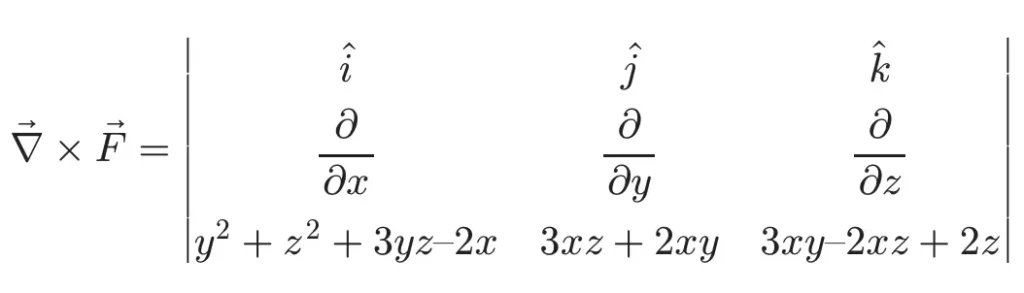
= $( 3x – 3x)\hat{i} – (-2z+3y-3y+2z)\hat{j} + (3z+2y-2y-3z)\hat{k}$
= $\vec{0}$.
As the curl of $\vec{F}$ is $\vec{0}$, so by definition the vector $\vec{F}$ is irrotational.
$\boxed{\color{blue}\textbf{Q 11}:}$ The position vector of a moving particle is given by .
$\vec{r}=x\hat{i}+y\hat{j}$
where
| $x=4t-\dfrac{t^2}{2}$. $y=3+6t-\dfrac{t^3}{6}$. |
Find the velocity and the acceleration of the particle at time t=2.
Solution:
$\boxed{\color{blue}\textbf{Q 12}:}$ Find a unit vector normal to the surface $x^3+y^3+3xyz=3$ at (1,2,-1).
Solution:
Given Φ = x3+y3+3xyz-3.
Therefore, $\vec \nabla \phi= \hat{i} \dfrac{\partial \phi}{\partial x} +\hat{j} \dfrac{\partial \phi}{\partial y}$$+\hat{k} \dfrac{\partial \phi}{\partial z}$
= $(3x^2+3yz)\hat{i}$ $+(3y^2+3xz)\hat{j}+3xy\hat{k}$
So, at (1,2,-1), $\vec \nabla \phi= -3\hat{i}+9\hat{j}+6\hat{k}$.
This is a vector normal to the given surface at (1,2,-1). So the desired unit normal is equal to
$\dfrac{-3\hat{i}+9\hat{j}+6\hat{k}}{\sqrt{(-3)^2+9^2+6^2}}$
= $\dfrac{1}{3\sqrt{14}} (-3, 9, 6)$
= $\dfrac{1}{\sqrt{14}} (-1, 3, 2)$
= $\dfrac{1}{\sqrt{14}} (-\hat{i}+3\hat{j}+2\hat{k})$.

This article is written by Dr. Tathagata Mandal, Ph.D in Mathematics from IISER Pune (Algebraic Number Theory), Postdocs at IIT Kanpur & ISI Kolkata. Currently, working as an Assistant Prof. at Adamas University. Thank you for visiting the website.