This is the page for Differential Equation practice problems. Here, a list of practice problems will be given for the course on Differential Equation (Exercise).
Final Sem Practice Problems
The set of practice problems is divided into two parts: Ordinary Differential Equation and Partial Differential Equation.
Ordinary Differential Equation Problems
Q1: Eliminate A and B from to form an ODE, where A and B are constants.
- y = e-x(A + Bx)
- y = A cosx + B sinx
- (x-A)2+y2=7
- y=2Ax+A2
Q4:
- Evaluate $\dfrac{1}{D-2}e^{2x}$.
- Show the set {cos2x, sin2x} is linearly independent.
Q5: Solve the following differential equations.
- $\dfrac{d^2y}{dx^2}-6\dfrac{dy}{dx}+9y=1+x+x^2$
- $\dfrac{d^2y}{dx^2}+9y=\sin 2x \cos x$
- $(D^2-5D+4)y=e^x$
- $\dfrac{dy}{dx}+\dfrac{y}{x}= \dfrac{y^2}{x^2}$ [Full Solution]
- $\dfrac{dy}{dx}+y \tan x= y^3 \sec x$ [Full Solution]
- $\dfrac{dy}{dx}+\dfrac{y}{x}=x^2 y^6$ [Full Solution]
Q5. Find the complementary function and the particular integral of [How to Find Particular Integral]
| (i) $\dfrac{d^2y}{dx^2}+4y= \sin^2{x}$. (ii) $\dfrac{d^2y}{dx^2}+2 \dfrac{dy}{dx}+y=x^2+e^{-x}$ (iii) $\dfrac{d^2y}{dx^2}-4 \dfrac{dy}{dx}+4y=xe^{2x}$. |
Q6: Using variation of parameters, solve the differential equation
- $\dfrac{d^2y}{dx^2}+y= \text{cosec}~x$
- $\dfrac{d^2y}{dx^2}+4y= \tan 2x$
Q7: Solve the Cauchy-Euler differential equation
$x^2 \dfrac{d^2y}{dx^2}-3x \dfrac{dy}{dx}+4y=\cos(\ln x)$
Q9: (a) Show the function f(x,y) = xy2 satisfies the Lipschitz condition on the rectangle |x| ≤ 1 and |y| ≤ 1.
(b) Find the interval in which the initial value problem (IVP)
$\dfrac{dy}{dx}=y^2, \quad y(1)=1$
has a unique solution.
Q10: Practice Problems on Wronskian discussed in the class, like definition, Abel’s formula, how to solve problems (see class note).
Partial Differential Equation (PDE) Problems
Q1: Discuss the types of a first order PDE with examples.
Q2: Solve x(y-z)p + y(z-x)q = z(x-y) using Lagrange’s method.
Q3: Solve the following PDEs:
- $x^2p+y^2q=(x+y)z$
- $p+3q=5z+\tan(y-3x)$
Q4: Find the region in which the partial differential equation $y\dfrac{\partial^2u}{\partial x^2} – x\dfrac{\partial^2u}{\partial y^2}+x^2u=0$ is hyperbolic.
Q5: Solve the initial value problem $\dfrac{\partial u}{\partial x} + 2\dfrac{\partial u}{\partial y}=0$. Find the value of $u(1,1)$ if $u(0,y)=4e^{-2y}$
Q6: Practice the problems regarding Charpit’s method. (see class note)
Applications of Differential Equation
Q1: Define an orthogonal trajectory for a family of curves. Find the orthogonal trajectory of the family of curves: [How to Find Orthogonal Trajectory]
- $y^2=2ax$
- $xy=a^2$
- $x^{2/3}+y^{2/3}=a^{2/3}$
where $a$ is a parameter.
Q2: The coordinates of a moving particle are given by $x=t^2$ and $y=t^3$. Find the velocity and acceleration of the particle when $t=1$.
Study Material: (more will follow soon)
End of Final Sem Practice Problems
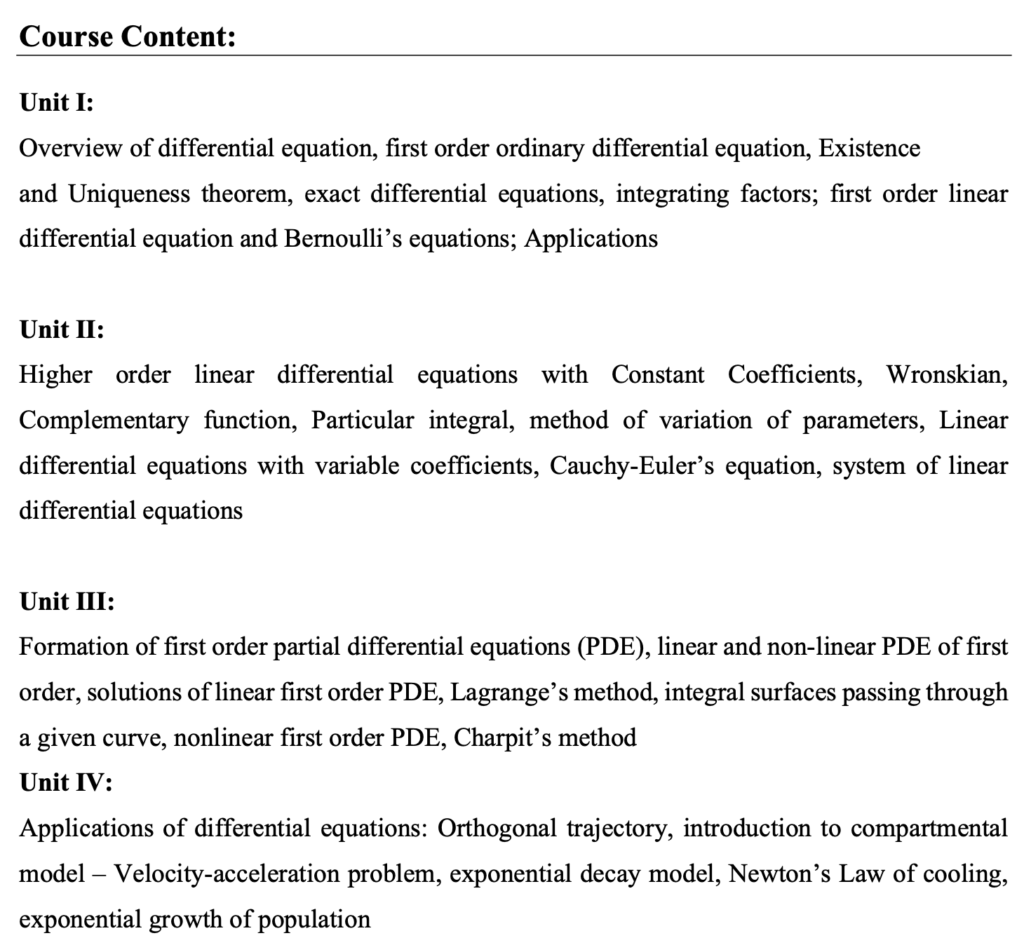
Syllabus:
Ordinary Differential Equation (ODE) Problems
Q1: What is an integrating factor of an ordinary differential equation. Write down all possible integrating factors of $xdy-ydx=0$?
Q2: Define order and degree of an ODE? Find order and degree of the following ODE:
- $\frac{dy}{dx}=\cos(x+y)$
- $\frac{d^2y}{dx^2}+\frac{dy}{dx}=\sqrt{x+y}$.
Q3: Eliminate A and B to form an ODE: [Full Solution]
- y = e-x(Acosx + Bsinx).
- y = 2Ax+A3
Q4: Solve $\dfrac{dy}{dx}=\sin(x+y)+\cos(x+y)$.
Q5: Solve the homogeneous differential equation: $x\dfrac{dy}{dx}=y-\sqrt{x^2+y^2}$
Q6: When a function f(x,y) is said to satisfy Lipschitz condition in y. Show that the function $f(x,y)=xy^2$ satisfies the Lipschitz condition on th rectangle 𝑅: |𝑥| ≤ 1, |𝑦| ≤ 1, but does not satisfy a Lipschitz condition on the strip 𝑆: |𝑥| ≤ 1, |𝑦| < ∞.
Q7: Solve $\dfrac{dy}{dx}=(4x+y+1)^2$.
Q8: Solve the differential equations:
- $\frac{dy}{dx}+y \cot x=\text{cosec}~ x$
- $x \dfrac{dy}{dx}+y=x^3y^6$.
Q9: Solve $\dfrac{dy}{dx}=\dfrac{y}{x}+\tan\left( \dfrac{y}{x}\right)$
Q10: Compute the particular integral $\dfrac{1}{D+1}e^{-x}$.
Q11: Show that {e-x, e2x} is a linearly independent set.

This article is written by Dr. Tathagata Mandal, Ph.D in Mathematics from IISER Pune (Algebraic Number Theory), Postdocs at IIT Kanpur & ISI Kolkata. Currently, working as an Assistant Prof. at Adamas University. Thank you for visiting the website.